
Compare Age With the Full Cost
An appliance's age and the diagnosed repair cost help you judge whether keeping it is sensible. Call us while you consider the options; you do not need a shopping list or a diagnosis to start the conversation.
The National Association of Home Builders and Bank of America Home Equity published these estimated service lives in their February 2007 Study of Life Expectancy of Home Components:
- Dishwashers: about 9 years.
- Washing machines: about 10 years.
- Gas and electric dryers: about 13 years.
- Standard refrigerators: about 13 years.
- Freezers: about 11 years.
- Microwave ovens: about 9 years.
- Electric ranges: about 13 years; gas ranges: about 15 years.
Those figures are planning estimates from an older study, not replacement deadlines. Use, upkeep, and the condition of the individual appliance matter. A machine beyond its estimated life may still justify a modest repair.
The half-the-price-of-new rule is a rule of thumb: when repairing an older appliance approaches or exceeds half the price of a comparable new one, compare replacement carefully. Add delivery, installation, removal, and any necessary connection or cabinet changes to the replacement side. One of our local appliance repair partners will explain the proposed work and its price before you authorize the repair.
Repair or Replace: Dishwasher
Repair deserves consideration when a dishwasher has one identified fault and the tub, racks, and door remain sound. A replaceable latch or pump may be worth addressing on an otherwise useful machine. For a dishwasher, repair or replace decisions also depend on recurring leaks, corrosion, and whether the correct part remains obtainable. Poor cleaning alone does not establish that the whole appliance needs replacing.
Repair or Replace: Washing Machine
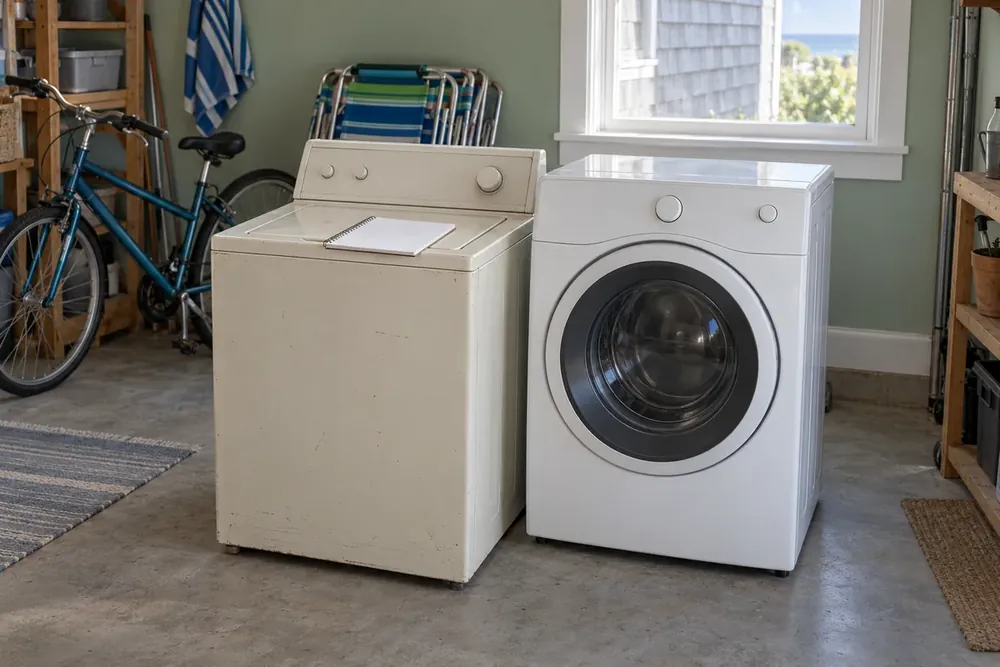
Repair is often a practical choice for a washer with an isolated problem and no broader damage. Compare the diagnosed fault with the condition of the drum, cabinet, and door. Repeated breakdowns or several worn components can shift the balance toward replacement. Include delivery access and the cost of reconnecting a replacement in the comparison.
Repair or Replace: Refrigerator
Repair can preserve a refrigerator that fits the kitchen and has a limited, repairable fault. A refrigerator repair vs. replace comparison needs the actual diagnosis: a door-seal problem and a sealed-system fault involve different work. For your refrigerator, repair or replace choices also depend on cabinet condition, recurring cooling failures, and the availability of the exact replacement part. Leave refrigerant work to your technician; call us about suspected sealed-system trouble.
Repair or Replace: Dryer
Repair may be worthwhile when a dryer has a single failed component and an otherwise sound drum and cabinet. For dryer repair vs. replace decisions, include the condition of the venting and the fuel connection. Long drying times can involve restricted airflow, so the symptom alone does not identify a failed heating part. A burning smell means stop using the dryer and call us.
Energy Use and Parts Affect the Choice
Energy use and access to the correct parts can change the value of a repair. Ask your technician which part failed and whether a suitable replacement can be obtained. A low repair quote is less useful if the appliance has other substantial faults.
The Federal Trade Commission recommends EnergyGuide labels for comparing energy use among similar appliances. The annual operating cost shown is an estimate based on typical use and a national energy price; your use and local rates affect the actual bill. Compare equivalent sizes and features, and avoid assuming that energy savings alone will repay a replacement quickly.
Built-In and Gas Appliances Need a Wider Comparison
Built-in and gas appliances require installation costs and connection needs in the replacement calculation. A new wall oven or integrated dishwasher must fit the opening and allow the required clearance. Gas connections, electrical changes, and cabinet alterations belong in the scope handled by the appropriate professional. Do not disconnect gas piping, remove a built-in unit, or open an appliance cabinet to investigate; call us about access concerns.
Safe to Try
Visible settings and accessible maintenance items are safe checks when the appliance has no warning signs. The checks can run while you are on the phone with us; calling never depends on finishing them.
- Read the selected cycle and check whether a control lock or delay is active.
- Look at accessible door seals and remove items preventing the door from closing.
- On an unplugged, cool unit, clear loose lint or debris from a user-accessible screen or filter as the manual directs.
- Look at a readily accessible water supply valve without disconnecting hoses or forcing the handle.
Call Us
Warning signs require stopping the appliance checks and getting help by phone.
- For sparks, a burning odor, or a breaker that trips during use, stop operating the appliance and call us; smoke or fire means leave and call 911 from outside.
- For water inside the cabinet, stay clear of wet electrical areas and call us.
- For work behind a panel or on a sealed cooling system, leave the unit closed and call us.
- For a gas smell, leave the home without operating switches and call the gas utility or 911 from outside.
Use the appliance repair cost guide to understand what enters a repair quote, and call about the appliance's current symptoms.