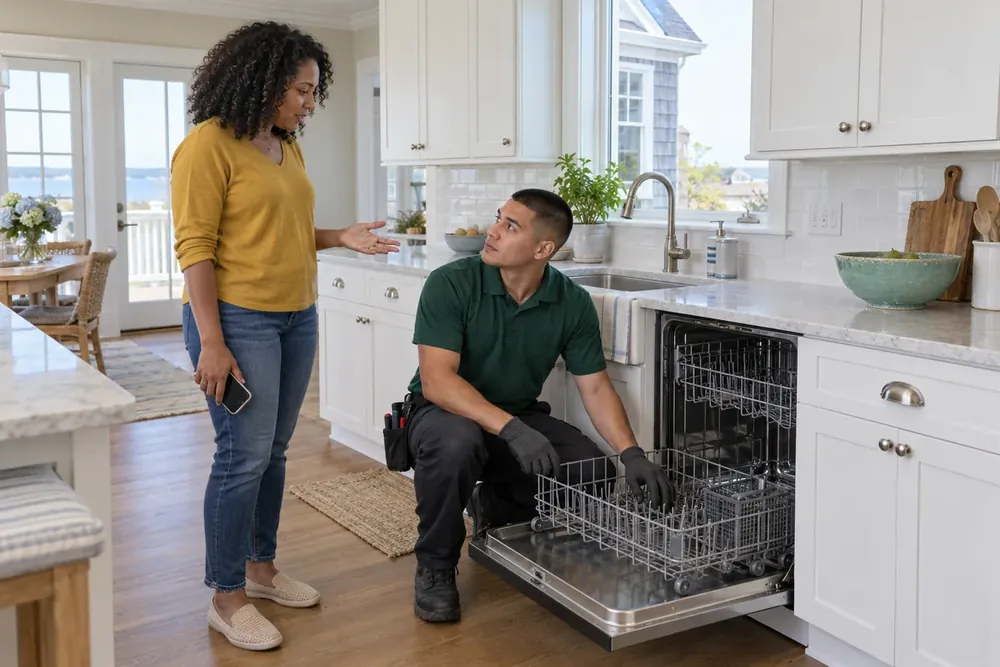
Start with the symptom
Your call starts with the appliance, your town and the problem you noticed. Ordinary descriptions work: the refrigerator feels warm, the washer leaves water in the drum, or the oven never reaches the selected temperature. You do not need to identify a failed part or understand an error message to call.
Say whether the problem happens every cycle or only sometimes. Describe a sound or leak you have already noticed without running another cycle to demonstrate it. Mention a burning odor, sparks or water inside the cabinet immediately. Those symptoms mean leaving the appliance off and discussing the next step by phone.
Share details within easy reach
An accessible model label or displayed error code helps narrow down the appliance details. Read either during the conversation when doing so is safe. A missing label does not delay the call. Do not pull out a heavy refrigerator, reach behind a gas range or remove a panel to find a number.
Tell us whether the machine is freestanding, built in or part of a stacked laundry pair. Mention stairs or a narrow laundry closet if they affect access. Observations about the layout help your technician plan the visit without requiring you to measure, dismantle or move anything.
Keep safe checks simple
Safe checks can run alongside the call when the appliance has no warning signs. Use the relevant appliance page for the checks suited to your machine.
Safe to try
- Look at the selected cycle, delay setting and control lock.
- Check that the door closes without clothing or packages in the way.
- Inspect a removable lint screen with the dryer off.
Call us
- Leave panels closed if diagnosis requires internal access, and call.
- Stop use for sparks, burning smells or repeated breaker trips, and call us.
- For gas odor, leave the home, avoid switches and call the gas utility or 911 from outside.
Arrange the visit
The call connects you with one of our local appliance repair partners, who sets the visit with you. Explain any entry instructions and the appliance's location during that conversation. You can also raise questions about diagnostic charges, the examination and how the repair decision will be presented.
Understand the diagnosis and authorize work
Your technician examines the appliance and explains the cause of the reported problem. A symptom alone does not establish which part needs replacement. Testing may reveal a door-switch issue, a water-flow problem or another fault with a different repair approach.
The explanation includes the proposed work and its price before any repair begins. Discuss parts, labor and any additional visit needed for the repair. You decide whether to authorize the work after hearing the findings. If replacement deserves consideration, ask how the appliance's condition affects that recommendation.
Review the result
Your technician checks the repaired functions after completing the agreed work. Discuss what was changed and how to use the appliance afterward. Keep the repair details for reference, especially if the symptom returns. For a broader comparison of the options, the repair or replace page explains which costs and condition factors to weigh.